Citizens in the EU skeptical about the admission of Balkan countries, FAZ: Polls show the least support for Kosovo and Serbia

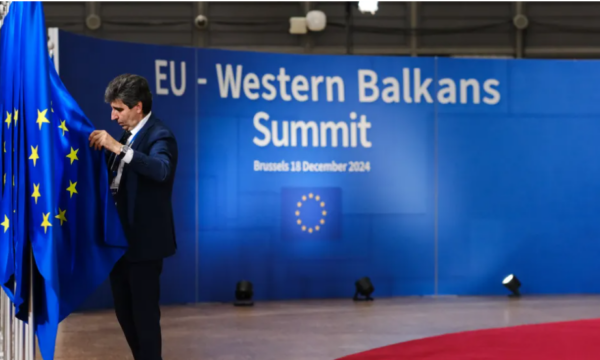
In Austria and Germany, skepticism about EU enlargement, especially when it comes to the Western Balkans, prevails. For this reason, Montenegro hopes that it can join the Union together with Iceland, DW quotes the German newspaper FAZ.
The majority of citizens in Germany and Austria oppose the possible enlargement of the European Union, writes the Frankfurter Allgemeine Zeitung (FAZ), referring to a Eurobarometer survey published in September 2025. At the EU level as a whole, 56 percent of respondents support the admission of new members. However, in Germany and Austria, with 49 and 45 percent support respectively, supporters of enlargement are in the minority. In the Czech Republic and France, only 43 percent of respondents support the idea of admitting new countries.
“The rejection is partly related to the weak image of the candidates,” FAZ emphasizes, recalling that apart from Turkey – which officially has candidate status, but has not played a significant role in the enlargement debates for years – the other candidate countries are from Eastern Europe: six from the Western Balkans, as well as Moldova, Ukraine and Georgia, which is currently not considered a serious candidate.
The text emphasizes that in all these countries, economic performance is below the average of the current EU member states. “This does not cause enthusiasm, especially in Austria and Germany. The candidates are often perceived as countries that take more than they give. This perception is unfair, but nevertheless present in public opinion,” writes FAZ.
Only 15 percent want Serbia in the EU
It is added that even in “skeptical Austria” there is support for EU enlargement, but only when it comes to Norway, with 62 percent, and Iceland, with 57 percent support – a similar situation exists in Germany.
“Norway and Iceland do not inspire fear and are perceived as a potential enrichment for the European Union. While the issue of Norwegian membership is currently not on the agenda, Iceland could soon become a relevant candidate – if citizens decide in a referendum planned for the end of August to continue membership negotiations, which were suspended in 2015,” writes the author of the text, Michael Martens.
At the same time, it is noted that the majority of EU citizens reject the membership of Balkan and Eastern European countries. “Only 25 percent of respondents in Austria support the entry of Bosnia and Herzegovina into the EU. Although this is the highest percentage among the so-called ‘undesirables’, it remains very low,” writes Martens.
According to him, Montenegro, North Macedonia and Ukraine each have 20 percent support, Albania 17 percent, while Moldova 16 percent. Serbia and Kosovo have the lowest support, with 15 percent of respondents supporting their EU membership.
Montenegro in a package with Iceland?
These results are particularly unfavorable for Montenegro, which the European Commission has considered a “leader” among Balkan candidate countries for years. European Commission President Ursula von der Leyen often highlights Podgorica’s progress. Montenegro is the only candidate to have opened all 33 negotiation chapters and has closed more chapters than any other country – 14 in total. The goal is membership by 2028.
However, the authorities in Podgorica are aware of the reservations towards the Balkan countries. For this reason, according to FAZ, the idea has arisen that Montenegro should try to enter the EU together with a country that is less controversial. If the Icelandic referendum supports the continuation of negotiations, Montenegro could try to use Iceland’s positive image and realize a so-called “tandem membership”. If the doors of the EU are opened to Iceland, Montenegro would “enter together with it”. Numerically, this would not be a problem, since the two countries together have a little more than a million inhabitants.
FAZ also writes that the Montenegrin newspaper Pobjeda has spoken with the Icelandic Foreign Minister, Katrín Gunnarsdóttir. Asked about the possibility of a joint entry of Montenegro and Iceland into the EU, she did not give a direct answer. However, when asked whether new member states should be admitted without a veto right in order to preserve the functionality of the EU, she replied that “Iceland believes in cooperation on equal terms and any agreement with the EU should reflect this.”
“This is also the official position of Montenegro. Whether such an approach is realistic can be seen as early as next year,” concludes Mihael Martens in the article for the Frankfurter Allgemeine Zeitung.